


Digital Banking vs Traditional Banking: What Businesses Choose in 2026
Digital Banking vs Traditional Banking: What Businesses Choose in 2026
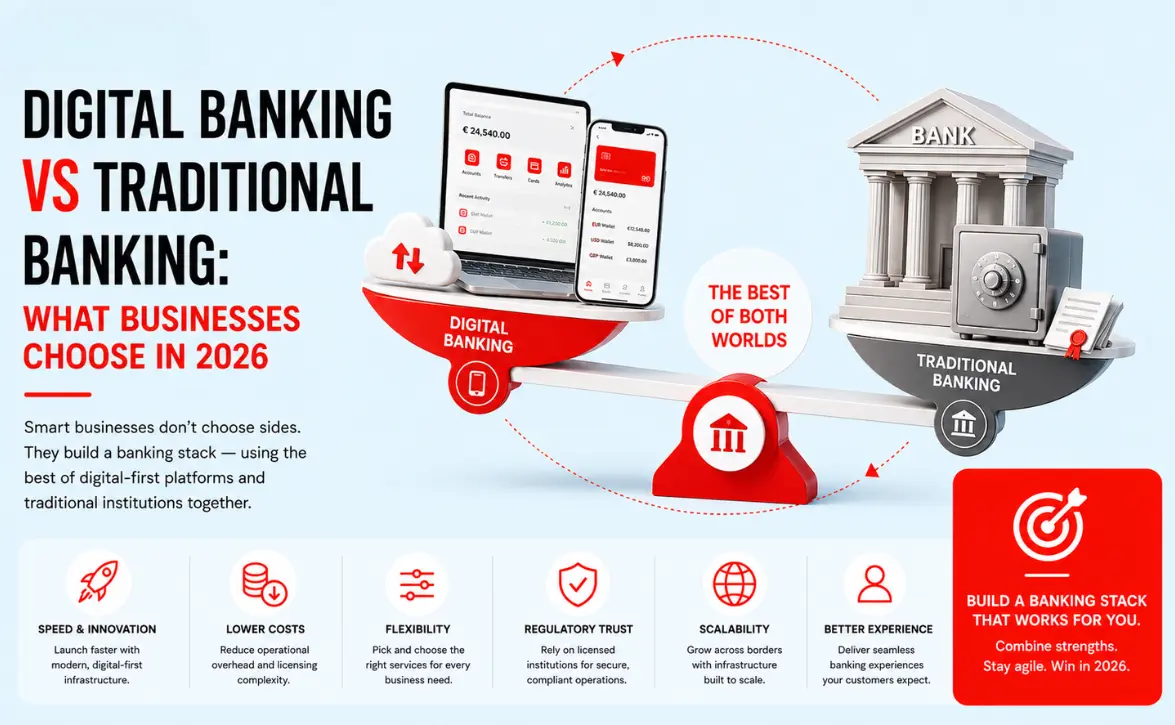
For years, "digital banking vs traditional banking" was framed as a binary decision — pick a side and stay there. That framing no longer holds, especially across the European Union. In 2026, the businesses making the smartest financial decisions aren't choosing one model over the other. They're building a stack, pulling specific capabilities from digital-first providers and specific capabilities from legacy institutions, and treating the whole arrangement as infrastructure rather than a single relationship.
This shift didn't happen by accident. It's the result of years of fintech maturation, a regulatory environment actively designed to open up banking data and competition through PSD2 and now PSD3, and an SME population across France, Germany, Italy, Spain, the Netherlands, and the rest of the EU that has simply gotten used to opening a current account in minutes instead of weeks. Understanding how that shift actually plays out — where digital banks win, where traditional banks still hold ground, and how growing companies are combining the two — is now a genuine competitive question, not a philosophical one.
It's also a question that increasingly applies not just to businesses choosing where to bank, but to banks and fintechs themselves choosing how to compete. Platforms like EBank, a white-label neo-banking solution from ATNM Digital Solutions, are a direct response to this shift — giving European banks, fintechs, and enterprises a way to launch a fully digital, EU-ready banking experience without spending years and tens of millions of euros building one from scratch.
The Numbers Behind the Shift
The scale of the migration toward digital banking across Europe is no longer a fringe trend. Industry research puts the European neobanking market on a growth path measured in double-digit CAGR through the end of the decade, with roughly 60 digital-only banks now active in the euro area alone. Business accounts have become the fastest-growing single segment of that market, driven by SMEs looking for lower fees, faster onboarding, and tighter software integration than most legacy institutions can offer.
Open banking adoption tells a similar story. The European Economic Area now counts tens of millions of open banking users, and the ongoing transition from PSD2 to PSD3 and the accompanying Payment Services Regulation is specifically designed to raise API quality and expand data-sharing obligations across banks, standardising the kind of access that fintechs and neobanks depend on. On the lending side, EU SME surveys consistently show a growing share of financing applications now going through fintech and online lenders rather than exclusively through a business's house bank, even as traditional banks — particularly savings banks and cooperative banks in markets like Germany and France — retain the edge on larger or more complex credit decisions.
Put together, those figures describe a market that hasn't rejected traditional banking so much as unbundled it. European businesses are taking the parts they need — speed, low fees, software integration, cross-border SEPA payments — from digital providers, and keeping the parts that still work better through an established institution.
Where Digital Banking Wins
Speed of onboarding
A business current account that used to take a branch visit and days of paperwork now takes minutes through a digital-first provider, with instant card issuance, e-KYC identity verification, and same-day access to funds. For founders trying to get a company off the ground anywhere in the EU, this alone is often decisive.
Cost structure
Digital banks and fintech platforms built without branch networks carry a fraction of the overhead of a legacy institution, and it shows in pricing. Zero monthly fees, no minimum balance requirements, and free or low-cost SEPA transfers are now table stakes rather than a differentiator — something that was rare a decade ago and is now simply expected.
Software-native design
This is arguably the biggest driver of the shift. Modern European businesses run on accounting and ERP tools, and they expect their bank to plug into that stack rather than sit apart from it. Digital banking platforms are frequently built API-first, meaning reconciliation, expense categorisation, and cash-flow forecasting can happen automatically instead of through manual exports.
Yield on idle cash
With euro area interest rates still meaningfully above zero, digital banks and money-market-linked business savings products routinely offer better yields on operating cash than the near-zero rates many legacy branch accounts still pay by default.
Embedded finance
A growing number of European businesses no longer "choose a bank" in the traditional sense at all — they get paid, extend credit, and manage payroll through the same e-commerce, payroll, or vertical-SaaS platform they already use, with banking services quietly delivered underneath by a licensed partner institution. This is one of the fastest-growing corners of digital banking in the EU in 2026, and PSD3's push toward open finance is set to accelerate it further.
Where Traditional Banks Still Win
Complex credit and lending relationships
SME lending remains the clearest area where traditional institutions retain an advantage. Regional savings banks, cooperative banks, and long-established national banks continue to post strong approval rates on financing applications, and businesses that need a real underwriting conversation — not just an automated decision — still gravitate toward an established banking relationship.
Cash-heavy operations
Retailers, restaurants, and service businesses that handle physical currency on a daily basis still need branch and ATM access that most pure digital banks can't match. For these businesses, a strong domestic branch network isn't a nostalgic preference; it's operationally necessary.
Regulatory depth and full-service breadth
Traditional banks still offer the widest single-provider range of products — treasury management, merchant services, trade finance, commercial real estate lending, and dedicated relationship managers — under one institutional roof, backed by decades of regulatory infrastructure and deep local market knowledge.
Trust in a crisis
Surveys on customer trust consistently show that European businesses and consumers alike still lean toward established banks when the question is specifically about safeguarding funds during periods of volatility, even when they prefer a digital platform for everyday use. That trust gap is narrowing, but it hasn't closed.
The Real Trend: Businesses Are Splitting the Relationship
The most accurate way to describe 2026's banking landscape isn't "digital replacing traditional." It's European businesses deliberately splitting their financial operations across providers, each chosen for what it does best:
This multi-provider approach is showing up clearly in how banking-as-a-service and startup-focused platforms are being adopted across the EU. Venture-backed and scaling companies in particular have leaned into fintech platforms that offer treasury tools, native accounting integrations, and streamlined multi-currency and SEPA banking infrastructure — while still maintaining a line of credit or a lending relationship with a traditional institution once the business is large enough to need it.
It's worth noting that many "digital banks" operating in the EU aren't full-scope banks at all — they're fintech companies that partner with a licensed credit institution or e-money institution behind the scenes to hold funds and process transactions. That distinction matters less to the end user's daily experience than it once did, but it's still worth understanding before choosing a provider.
How to Decide: A Practical Framework
Rather than asking "digital or traditional," the more useful question for a business in 2026 is which specific banking function you're solving for:
Why White-Label Neo-Banking Platforms Like EBank Are Outpacing Traditional Banks
Everything covered above explains why businesses across Europe are migrating toward digital banking. But there's a second, quieter shift happening behind the scenes: the institutions and companies that serve those businesses are also rethinking how they deliver banking in the first place. Building a digital bank from the ground up — core banking engine, compliance layer, card issuing, mobile and web apps, fraud monitoring, PSD3-ready open banking APIs — historically took years and a budget only a handful of large banks could justify. That barrier is exactly what white-label neo-banking platforms are designed to remove.
EBank, the neo-banking platform developed by ATNM Digital Solutions, is a good illustration of how far this model has come — and why it now compares so favourably against a traditional bank's own in-house infrastructure, particularly for institutions operating in or entering the European market:
In other words, the same forces pulling European businesses toward digital banking are pulling banks and fintechs toward platforms like EBank. It's the infrastructure layer behind the shift this article describes: rather than traditional institutions trying to out-build digital-native competitors from scratch, white-label neo-banking gives them a way to become one.
The Bottom Line
The "digital banking vs traditional banking" debate that defined the last decade has largely resolved itself across Europe — not because one side won, but because the framing was too narrow to begin with. In 2026, competitive EU businesses treat banking the way they treat any other part of their technology stack: composable, provider-agnostic, and built around what each piece does best. Digital banking has won the daily-operations battle decisively. Traditional banking hasn't been displaced so much as pushed toward the roles it was always strongest at — credit, complexity, and trust at scale.
For most growing European businesses, the practical answer isn't a single choice at all. It's a deliberate combination of both, revisited as the business itself grows.
And for the banks, fintechs, and enterprises watching that shift from the other side of the counter, the takeaway is just as clear: the fastest way to keep pace with digital-native competitors is rarely to build a digital bank from zero. Platforms like EBank exist precisely to close that gap — turning what used to be a multi-year infrastructure project into a launch-ready, white-label neo-banking platform built for the European market, ready to go head-to-head with the digital challengers reshaping this industry.