


EBank vs. vCards: Which White Label Financial Platform Is Right for Your Business?
EBank vs. vCards: Which White Label Financial Platform Is Right for Your Business?
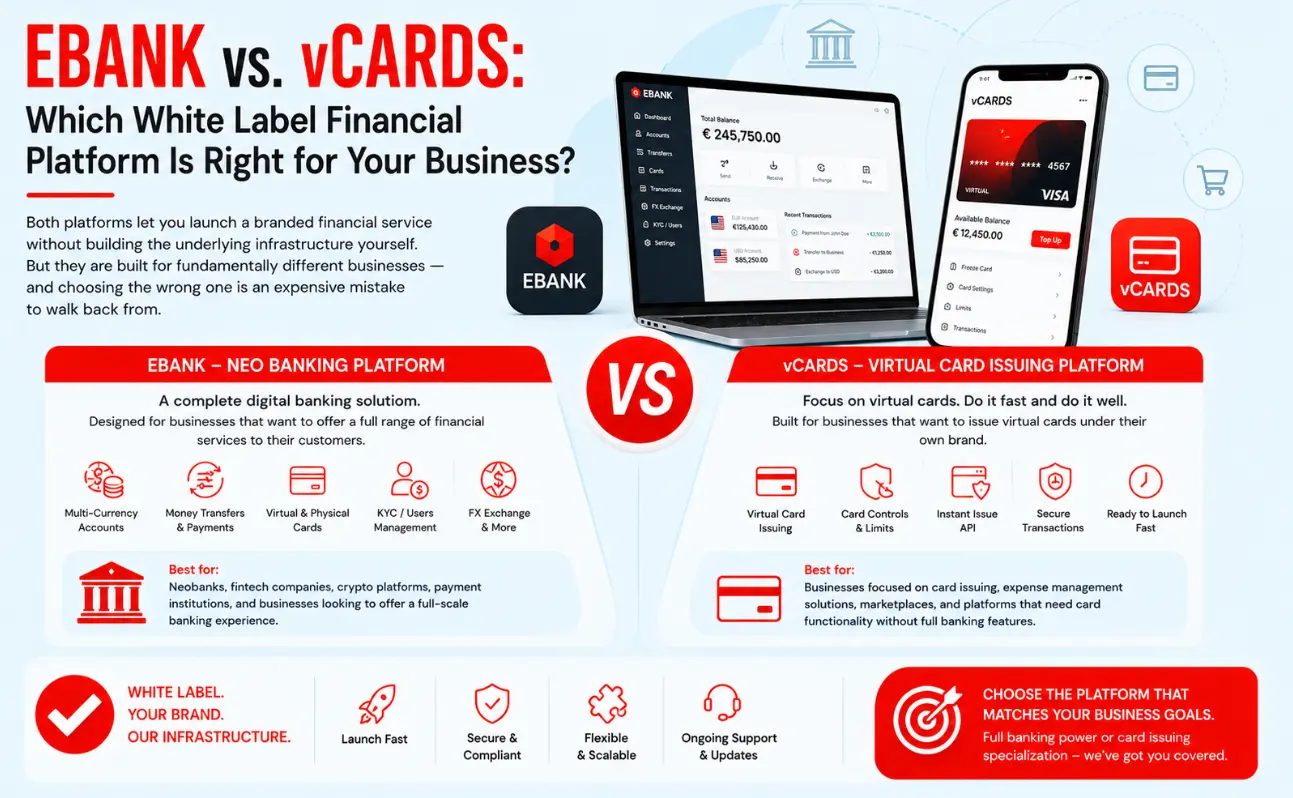
Both platforms let you launch a branded financial service without building the underlying infrastructure yourself. But they are built for fundamentally different businesses — and choosing the wrong one is an expensive mistake to walk back from.
Key Points
- vCards is a focused white label platform for operators who want to run a virtual card issuing business — card issuance, funding, and management are its entire purpose.
- EBank is a complete neo-banking platform in which card issuing is one of many modules, alongside multi-currency wallets, SEPA transfers, European vIBAN accounts, investment products, lending tools, and fixed deposits.
- Both platforms are available under Regular (monthly) and Commercial (annual) licenses; the Commercial License includes Operator Services, VPS hosting, priority support, and Android and iOS apps.
- The right choice depends entirely on the financial business model you are building — a standalone card product, or a scalable multi-service financial ecosystem.
Building a financial product under your own brand no longer requires developing infrastructure from the ground up. White label platforms handle the technology, letting operators focus on customer acquisition, fee structures, and the business itself. ATNM Digital Solutions offers two of these platforms — EBank and vCards — and on the surface they look like they might be alternatives to each other. They are not. They are built for different businesses, and understanding that distinction before you activate a license is the whole point of this article.
vCards: a business built around one product
vCards is a white label platform designed to do one thing well: let operators launch and run a virtual card issuing service under their own brand. The entire platform — its customer dashboard, its admin panel, its fee and commission logic — is oriented around the card. Everything else on the platform, including customer balances, deposits, and internal transfers, exists in service of the card business rather than as standalone financial products.
Customers on a vCards platform can create and manage virtual cards, fund them, view transaction history, complete KYC verification, and transfer balances between users. Operators get a centralised panel for managing customers, cards, card requests, deposits, commissions, KYC applications, and platform branding. Depending on the connected card issuing provider, cards may support Apple Wallet, Google Wallet, NFC payments, and in some cases ATM withdrawals.
The business model is clear and relatively simple to communicate: the operator earns from card issuance fees, funding fees, transaction commissions, monthly card maintenance, premium card plans, and foreign exchange markup. It is a focused product aimed at a focused audience — advertising agencies, media buying teams, freelancers, remote employees, e-commerce businesses, and anyone who needs cards for online payments, subscriptions, or corporate expenses.
EBank: a platform for building a complete financial ecosystem
EBank is something considerably more ambitious. It is a full neo-banking platform, and virtual card issuing is one module within it rather than the entire product. The other modules — multi-currency wallets, European vIBAN accounts, SEPA and SEPA Instant transfers, international bank transfers, currency exchange, investment accounts, fixed-term deposits, and a lending toolkit — sit alongside card issuance in a single platform that an operator can configure, expand, and build a multi-revenue financial business around.
EBank customers can hold a primary wallet and additional currency wallets, each with its own account number, balance, transaction history, and statements. Eligible European users can open a vIBAN account, receive EUR payments via SEPA, and send instant intra-EU transfers. The platform supports both personal and business customer accounts, with full KYC and KYB processing. Operators manage everything — customers, wallets, cards, transfers, compliance controls, fees, financial provider connections — through a single administration panel.
vCards is designed specifically for operating a virtual card issuing business. EBank is a complete neo-banking platform in which card issuing is only one of many available financial services.
— ATNM Digital SolutionsThe additional financial modules unlock multiple revenue streams that a card-only platform cannot generate. An EBank operator can earn from account opening and maintenance fees, deposits and withdrawals, domestic and international transfers, currency exchange markup, premium account plans, investment services, lending products, and fixed deposit instruments. The platform is designed to scale — an operator can launch with wallets and cards and add European vIBAN accounts, business customer support, investment modules, and deposit products as the business grows.
Feature comparison
| Feature | vCards | EBank |
|---|---|---|
| Core business model | Virtual card issuing service | Complete neo-bank and financial ecosystem |
| Virtual cards | Yes — the primary product | Yes — one of several modules |
| Multi-currency wallets | Card-focused only | Full multi-currency wallet system |
| European vIBAN | Not a core module | Available via Commercial License infrastructure |
| SEPA / SEPA Instant | Requires separate provider | Integrated through Operator Services |
| International transfers | Not a primary function | Yes, via connected providers |
| Currency exchange | Limited or provider-dependent | Full FX module |
| Investment accounts | No | Available |
| Lending tools | No | Available |
| Fixed-term deposits | No | Available |
| Business accounts | Depends on card program | Yes |
| KYC / KYB | Supported | Supported |
| Android and iOS apps | Commercial License | Commercial License |
| Primary advantage | Focused, accessible card business | Scalable multi-service financial platform |
Licensing
Both platforms are offered under two license types. The Regular License covers platform access, installation, hosting, updates, and technical support on a monthly subscription, but does not automatically include regulated financial services. Connecting card issuing, payment processing, vIBAN infrastructure, or SEPA rails requires the operator's own provider agreements or a separate Operator Services license.
The Commercial License is the more complete annual package. For both EBank and vCards, it includes Operator Services, VPS hosting, 24/7 priority support, one free custom development, and Android and iOS applications. For EBank, the Commercial License can further include EMI and BaaS provider infrastructure, European vIBAN integration, SEPA and SEPA Instant, card issuing integration, and KYC and KYB compliance handling — effectively a ready-to-launch neo-banking stack rather than a technology platform that still needs a financial layer bolted on.
Which platform should you choose?
Choose vCards when
- Virtual cards will be your primary product
- Your audience needs cards for advertising, subscriptions, or online payments
- You want a more accessible, focused entry into the fintech market
- You do not need a full account and transfer infrastructure
- A simpler operational and marketing model is a priority
Choose EBank when
- You want to launch your own neo-bank
- Your customers need multi-currency wallets and account infrastructure
- You want to connect European vIBAN accounts and SEPA payments
- You plan to serve both personal and business customers
- You want to combine cards with transfers, exchange, and additional financial services
- You are building a scalable financial ecosystem rather than a standalone card product
EBank and vCards are not interchangeable. They serve different business models at different levels of financial complexity. vCards is the right foundation for a focused virtual card issuing business. EBank is the right foundation for a complete neo-bank. The central question is not which platform is technically superior — it is what kind of financial service you are actually trying to build.
One note worth carrying into either decision: software technology does not substitute for a financial license. Card issuance, vIBAN accounts, customer fund safeguarding, and regulated payment execution depend on licensed financial providers, the selected jurisdiction, applicable KYC and KYB requirements, and the Operator Services infrastructure connected to your platform. The technology creates the surface; the licensed infrastructure underneath it is what makes the service real.