


How Operators Can Offer SEPA Accounts Without Becoming an EMI
How Operators Can Offer SEPA Accounts Without Becoming an EMI
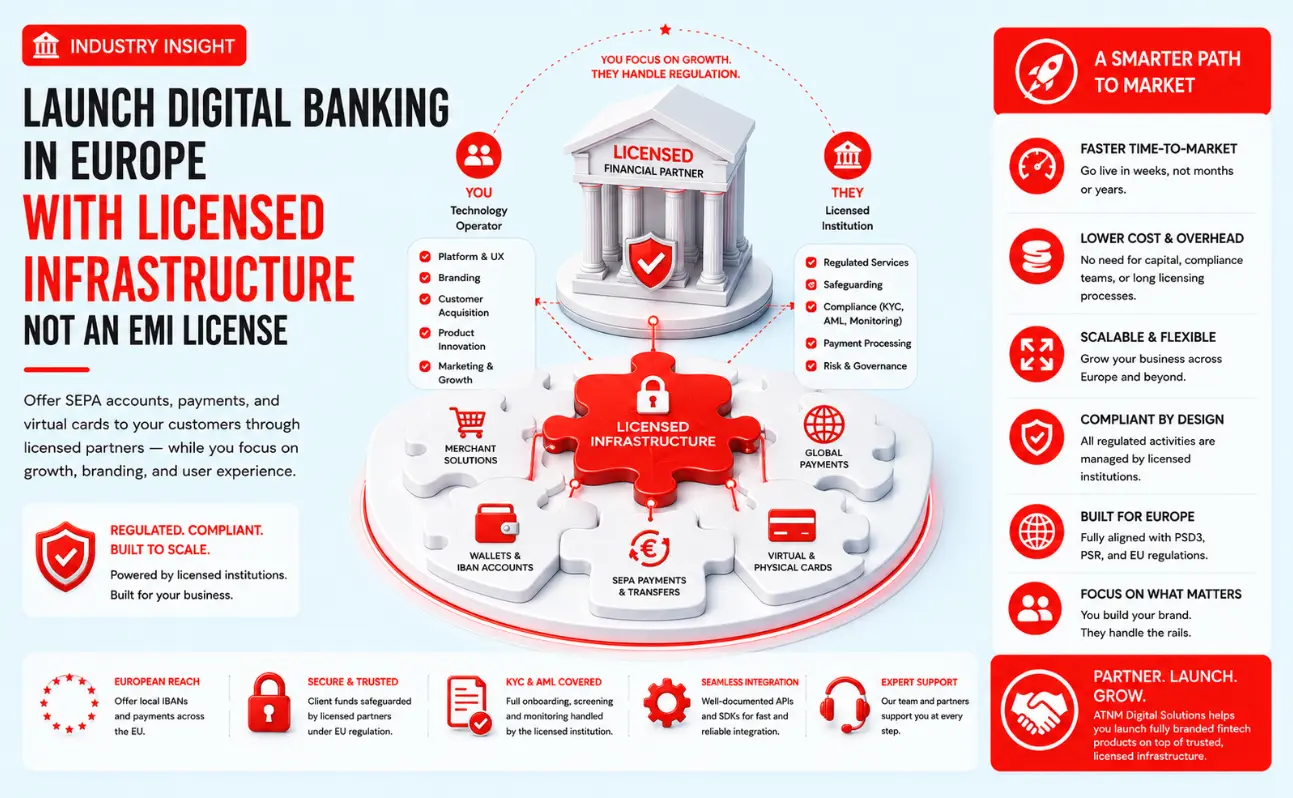
For years, launching a financial platform in Europe meant one thing: obtaining an Electronic Money Institution (EMI) licence, along with the capital, compliance teams, and months of regulatory review that come with it. In 2026, that's no longer the only route. Thanks to Banking-as-a-Service and licensed financial infrastructure, businesses can now launch digital banking products for their customers without becoming a regulated institution themselves — an approach already used by fintech startups, payroll platforms, marketplaces, crypto companies, remittance services, and business software providers across Europe.
In this article
The traditional approach
Historically, a company that wanted to offer payment accounts or issue electronic money had two options: apply for its own EMI licence, or operate as an agent of an existing licensed institution. Holding a licence gives greater operational control, but it also comes with substantial cost, ongoing regulatory obligations, and a much longer time to market — a path that simply isn't realistic for many startups and software companies.
The modern alternative: licensed financial infrastructure
Rather than becoming the regulated entity themselves, most operators today build on top of infrastructure already provided by a regulated institution. The operator concentrates on customer acquisition, branding, platform management, product development, and customer support, while the licensed institution remains responsible for regulated activities such as safeguarding client funds, compliance, and payment processing. The result is a much simpler path to launch, without stepping outside applicable regulation.
What can operators offer?
With modern Banking-as-a-Service infrastructure, operators can give their customers a digital banking experience that looks and feels like a traditional bank. Depending on the licensed infrastructure and geographic coverage selected, this can include:
Do operators need an EMI licence?
In most cases, no. When the regulated financial services are delivered through licensed partners, the operator can stay focused on running its platform and brand while the authorised financial institution handles the regulated side of the business. That said, the right legal structure always depends on the specifics — jurisdiction, business model, target markets, services offered, and applicable regulatory requirements — so every project should be assessed individually before launch.
What about KYC and AML?
Customer verification remains one of the most critical parts of any financial product. Depending on the infrastructure provider, onboarding may include identity verification, business verification (KYB), sanctions and PEP screening, AML monitoring, transaction monitoring, and ongoing compliance checks. These processes are typically built directly into the onboarding flow, so operators can offer a smooth customer journey while still meeting regulatory expectations.
Can operators offer SEPA accounts?
Yes. Through licensed financial infrastructure, operators can give customers access to EUR payment accounts connected to the SEPA network. Depending on the provider, this can cover receiving EUR transfers, sending SEPA and SEPA Instant payments, named payment accounts, multi-currency balances, and both corporate and individual account types. Exactly which of these are available depends on the partner's licence, geographic coverage, and commercial offering.
Why businesses choose white-label banking
Building a banking platform from the ground up is expensive and slow. White-label banking lets a company put its energy into growing the business instead of building infrastructure — with a faster time to market, lower development costs, reduced operational complexity, ready-made compliance infrastructure, modern APIs, a fully branded customer experience, and an architecture that scales. It's an option that fintech startups, established businesses, and software companies alike are increasingly turning to as they expand their product offering.
This model is already being used across a wide range of businesses, including fintech startups, payroll platforms, expense management software, crypto platforms, investment applications, business management software, freelance marketplaces, international payment platforms, and digital banking brands — each building its own customer experience on top of regulated infrastructure behind the scenes.
Launch Faster with ATNM Digital Solutions
EBank, our white-label digital banking platform, supports modern banking functionality including digital wallets, payment management, business accounts, virtual payment cards, customer onboarding, and API integrations. Combined with our Operator Services, businesses can leverage licensed financial infrastructure provided by regulated partners to launch branded financial solutions far faster than building an entire banking ecosystem from scratch. Whether you're building a fintech startup, expanding an existing software platform, or creating a new digital banking brand, white-label infrastructure offers a practical, scalable path to market — letting you focus on what matters most: growing the business and delivering value to your customers.