


How to Start a Proprietary Trading Firm in 2026: The Complete Guide
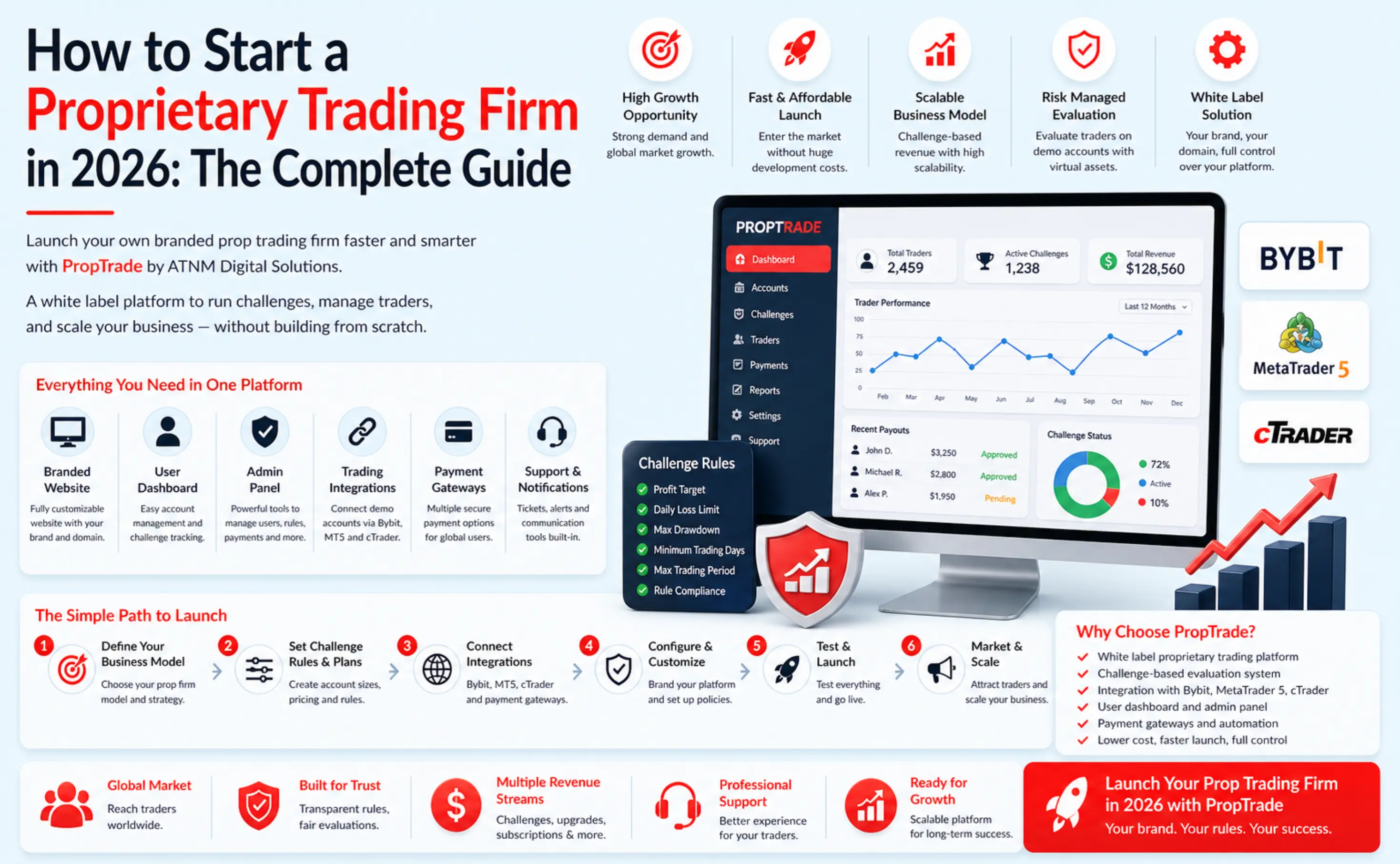
The proprietary trading industry has changed dramatically over the last few years. What was once a business model mainly associated with institutional trading desks, hedge funds, and large financial firms has now become one of the fastest-growing opportunities for fintech entrepreneurs, trading educators, brokers, and online business owners.
In 2026, launching a proprietary trading firm no longer requires building an entire trading infrastructure from scratch or investing millions of dollars into technology, development, and operations. With modern white label solutions, API-based integrations, automated challenge systems, and demo trading environments, entrepreneurs can now enter the prop trading market faster, more efficiently, and with significantly lower technical barriers.
This is where PropTrade by ATNM Digital Solutions becomes a practical solution for anyone looking to launch their own branded prop trading platform.
PropTrade is a white label proprietary trading platform designed for businesses that want to operate under their own brand, offer trading challenges, manage users, automate evaluations, and connect traders to integrated demo trading environments through platforms such as Bybit, MetaTrader 5, and cTrader.
Instead of spending months or years developing a platform from zero, PropTrade allows business owners to launch a ready-made prop trading solution with their own branding, domain, challenge rules, payment gateways, user dashboard, admin panel, and platform integrations.
What Is a Proprietary Trading Firm?
A proprietary trading firm, often called a prop firm, is a company that gives traders access to trading capital after they meet specific performance and risk management requirements. Traditionally, prop firms used their own internal capital to allow skilled traders to trade financial markets and share profits with the firm.
Modern online prop firms usually operate through an evaluation-based model. Traders purchase a challenge, trade on a demo account with virtual assets, and must prove their ability to follow trading rules, control risk, and achieve a required profit target.
With PropTrade, traders do not trade with client deposits during the challenge stage. They complete their evaluations on demo accounts using virtual assets through integrated trading platforms such as Bybit, MetaTrader 5, and cTrader. This allows the prop firm to evaluate trader performance without directly managing client funds during the challenge process.
This model has become popular because it creates a scalable business structure where the firm can sell challenge accounts, automate evaluations, manage risk rules, and identify skilled traders before offering any further opportunities.
Why 2026 Is a Strong Year to Start a Prop Trading Firm
The demand for funded trading opportunities continues to grow. Traders around the world are looking for ways to access larger simulated or funded accounts without depositing significant personal capital into exchanges or brokers. At the same time, online communities, trading educators, influencers, brokers, and fintech brands are looking for new monetization models.
A prop trading firm offers a powerful combination of digital product sales, recurring trader demand, performance-based incentives, and scalable technology.
In 2026, the opportunity is especially strong for several reasons:
Retail traders are more familiar with online trading platforms than ever before. Crypto, forex, indices, commodities, and CFD markets have become part of the everyday trading conversation. Many traders already use platforms like Bybit, MetaTrader 5, and cTrader, making onboarding easier.
White label technology has reduced the cost and complexity of launching. Instead of building a custom platform, business owners can use a ready-made system such as PropTrade and customize it under their own brand.
The challenge model is easier to scale than traditional brokerage models. Since traders complete evaluations on demo accounts with virtual assets, the business can focus on rules, automation, user acquisition, support, and trader experience.
Remote-first trading communities continue to grow. A prop firm can attract traders globally through social media, affiliates, trading communities, educational content, and paid advertising.
For entrepreneurs, this creates a clear opportunity: build a branded prop trading business without becoming a traditional broker and without developing complex infrastructure from the ground up.
The Main Prop Trading Business Models
Before launching a prop firm, it is important to choose the right business model. The model determines how traders join your platform, how your company generates revenue, and how risk is managed.
1. Evaluation-Based Challenges
This is the most common model in the modern prop trading industry.
A trader purchases a challenge account and must meet specific objectives, such as reaching a profit target while respecting daily loss limits, maximum drawdown, trading days, and other rules.
If the trader successfully passes the challenge, they may become eligible for the next stage, a funded phase, or another internal program depending on the firm’s policy.
This model is attractive because it creates upfront revenue from challenge fees while allowing the firm to evaluate traders before offering further opportunities.
With PropTrade, challenge rules can be configured inside the platform, and trader performance can be monitored through integrated demo accounts connected to Bybit, MetaTrader 5, or cTrader.
2. Instant Funding Model
In this model, traders pay a fee and receive access to an account immediately without passing a traditional evaluation phase.
This model can attract traders who want faster access, but it usually requires stricter risk controls and more careful account management. It may also create higher exposure for the firm if not managed properly.
For new prop firms, the instant funding model should be introduced carefully and only when the business has strong rules, monitoring tools, and clear payout policies.
3. Hybrid Model
Many modern prop firms combine evaluation-based challenges with instant funding, subscriptions, account scaling, or premium add-ons.
For example, a firm may offer:
Standard challenges for beginner traders
Advanced challenges for experienced traders
Monthly subscription access to analytics or educational tools
Account scaling for consistent performers
Premium dashboards or trader reports
Community access through Discord, Telegram, or WhatsApp
PropTrade can support this type of business structure by allowing operators to create multiple account types, define challenge conditions, and build a branded trader journey from registration to evaluation.
How Prop Firms Make Money
A proprietary trading firm can generate revenue in several ways. The exact structure depends on the business model, target market, pricing strategy, and trader acquisition channels.
The most common revenue streams include:
Challenge fees
Upgrade fees for larger account sizes
Add-ons such as analytics, education, or priority support
Profit sharing with successful traders
Community memberships
Affiliate partnerships
The challenge fee model is usually the foundation. Traders pay to access an evaluation account, and the firm earns revenue from each challenge purchase.
For example, a prop firm may offer different account sizes such as $5,000, $10,000, $25,000, $50,000, or $100,000 in virtual demo capital. Each account size has a different price, rule set, and profit target.
Because PropTrade is a white label system, the operator can structure these offers under their own brand and create a pricing model that matches their market.
Core Technology Needed to Start a Prop Firm
A prop trading firm is not just a website. It requires a complete operational system that connects users, payments, trading accounts, challenge rules, admin management, and support.
The key technology components include:
1. Branded Website
Your website is the public face of your prop trading firm. It should clearly explain your challenge rules, account sizes, pricing, payout policy, trading platforms, terms, and risk disclaimer.
A professional website builds trust and helps convert visitors into registered traders.
With PropTrade, your platform can be launched under your own domain and brand identity, giving your business a professional appearance from day one.
2. User Dashboard
The user dashboard is where traders manage their account, purchase challenges, view progress, check account rules, follow performance, submit support requests, and access trading platform details.
A clean and transparent dashboard is critical because traders want to know exactly where they stand during the evaluation process.
PropTrade includes a trader cabinet designed for this purpose, allowing users to manage their activity directly from your branded platform.
3. Admin Panel
The admin panel is the control center of your prop firm.
From the admin side, the business owner or team must be able to manage users, payments, challenges, accounts, rules, support, notifications, platform settings, and reports.
4. Trading Platform Integrations
A prop firm needs to connect traders to a trading environment. In the case of PropTrade, challenge accounts are completed on demo accounts with virtual assets through integrated trading platforms such as:
Bybit
MetaTrader 5
cTrader
This is important because traders can use familiar trading environments while the prop firm can track challenge performance, risk limits, and account progress.
Using demo accounts with virtual assets helps separate the evaluation process from real client fund management. Traders are tested based on performance and rule compliance, not by depositing funds into the prop firm.
5. Challenge and Evaluation System
The challenge engine is one of the most important parts of a prop trading business.
It must track rules such as:
Profit target
Daily loss limit
Maximum drawdown
Minimum trading days
Maximum trading period
Account size
Trading instruments
Rule violations
Challenge status
Upgrade or failure conditions
A weak evaluation system can create disputes, confusion, and support problems. A strong system creates transparency and trust.
PropTrade is designed to help operators manage challenge-based prop trading models by connecting trader activity with platform rules and admin controls.
6. Payment Gateways
To sell challenges, your platform needs secure and convenient payment methods.
Depending on your market, this may include card payments, crypto payments, local payment methods, or manual payment options.
A good payment setup improves conversion rates because traders are more likely to purchase a challenge when their preferred payment method is available.
PropTrade can be connected with payment gateways depending on the operator’s business needs and target regions.
7. Notifications and Communication Tools
Communication is essential in prop trading. Traders need updates about their account status, challenge results, rule violations, payments, support tickets, and platform announcements.
PropTrade can support communication through email notifications, platform alerts, and messenger widget integrations such as WhatsApp, Telegram, or Discord depending on the operator’s setup.
This helps the business stay connected with users and provide faster support.
Legal and Compliance Considerations
Starting a prop trading firm requires careful legal planning.
In many jurisdictions, prop firms that operate evaluation models using demo accounts with virtual assets are not the same as brokers or investment managers, especially when they do not accept client deposits, do not manage client funds, and do not provide investment advice.
However, legal requirements vary by country and region. Before launching, every operator should consult a qualified legal professional in the jurisdiction where the company is registered and where it plans to market services.
Important legal documents may include:
Terms and Conditions
Privacy Policy
Refund Policy
Risk Disclaimer
Challenge Rules
Payout Policy
AML/KYC Policy if required
User Agreement
The most important point is clarity. Traders must understand what they are buying, how the challenge works, what is simulated, what rules apply, when they pass or fail, and what payout conditions exist.
PropTrade provides the technology infrastructure, but each operator remains responsible for setting correct business policies, legal disclosures, and compliance procedures for their market.
Building Your Prop Firm Brand
Technology alone is not enough. The most successful prop firms build strong brands.
Your brand should answer several questions:
Why should traders choose your firm?
Are your rules clear and fair?
Do you offer fast support?
Are payouts transparent?
Do traders trust your platform?
Do you provide education, community, or mentorship?
Is your challenge structure competitive?
In 2026, traders compare prop firms carefully. They look at pricing, rules, payout reputation, platform stability, community feedback, and social proof.
A strong brand should include:
Professional website design
Clear account plans
Transparent rules
Fast support
Active social media
Educational content
Affiliate program
Trader testimonials
Regular platform updates
Community channels
With PropTrade, you receive the technical foundation. Your role as the operator is to build trust, attract traders, manage the community, and create a strong market position.
Suggested Launch Roadmap
Launching a prop firm becomes much easier when you follow a structured roadmap.
Step 1: Define Your Business Model
Decide whether your firm will offer evaluation challenges, instant funding, subscriptions, or a hybrid model.
For most new operators, the evaluation-based model is the safest and most scalable starting point.
Step 2: Choose Your Trading Platforms
Decide which trading platforms you want to offer to your traders.
With PropTrade, challenge accounts can be connected to demo environments with virtual assets through platforms such as Bybit, MetaTrader 5, and cTrader.
This gives traders flexibility and allows your firm to serve different types of users.
Step 3: Create Challenge Plans
Define your account sizes, prices, profit targets, drawdown limits, trading rules, and passing conditions.
Your challenge rules must be simple enough for traders to understand but strong enough to protect your business model.
Step 4: Prepare Your Legal Pages
Before accepting users, prepare all legal documents and policies.
This includes your terms, refund policy, risk disclaimer, privacy policy, and payout rules.
Step 5: Launch Your White Label Platform
Set up your PropTrade platform under your own domain, logo, colors, brand name, payment methods, and platform settings.
This gives you a ready-made foundation without the time and cost of custom development.
Step 6: Test the Full User Flow
Before launching publicly, test every important process:
Registration
Email verification
Challenge purchase
Payment confirmation
Demo account connection
Trading platform access
Rule tracking
Challenge progress
Admin management
Support request
Notifications
Testing is essential because even small issues can damage trust during launch.
Step 7: Start Marketing
Once your platform is ready, begin attracting traders.
Effective marketing channels for prop firms include:
Facebook and Instagram Ads
Google Ads
YouTube content
TikTok and Instagram Reels
Trading influencers
Affiliate partnerships
Telegram communities
Discord groups
SEO blog content
Email marketing
WhatsApp follow-ups
Your marketing should focus on trust, clarity, and opportunity. Traders need to understand why your firm is different and why your challenge is worth purchasing.
Why Choose PropTrade as Your White Label Prop Trading Solution?
Building a prop trading platform from scratch can be expensive, time-consuming, and technically difficult.
You would need to develop a website, user dashboard, admin panel, payment system, challenge engine, account management tools, trading platform integrations, notifications, support workflows, security features, and reporting systems.
For many entrepreneurs, this creates a major barrier to entry.
PropTrade solves this problem by giving you a ready-made white label platform that can be launched under your own brand.
With PropTrade, you can focus on growing your business instead of spending months building the technology.
Key advantages include:
White label branding under your own company name
Prop trading challenge system
User dashboard for traders
Admin panel for platform management
Integration with demo accounts using virtual assets
Support for platforms such as Bybit, MetaTrader 5, and cTrader
Payment gateway integration options
Flexible challenge structures
Scalable business model
Faster launch compared to custom development
Lower startup cost compared to building from zero
PropTrade is designed for entrepreneurs, fintech companies, trading educators, brokers, and online business owners who want to enter the prop trading market with a professional platform and a faster time to market.
Final Thoughts
Starting a proprietary trading firm in 2026 is one of the most attractive opportunities in the fintech and online trading space. The market is growing, trader demand remains strong, and white label technology has made it possible to launch faster than ever before.
However, success requires more than just a website. A serious prop firm needs a complete platform, clear rules, reliable integrations, transparent policies, strong branding, and a scalable acquisition strategy.
PropTrade by ATNM Digital Solutions gives entrepreneurs a practical way to enter this market with a ready-made white label proprietary trading platform. It allows you to operate under your own brand, sell trading challenges, manage users, connect demo accounts with virtual assets through Bybit, MetaTrader 5, and cTrader, and build a professional prop trading business without developing the entire infrastructure from scratch.
For brokers, trading communities, fintech entrepreneurs, educators, and digital business owners, PropTrade offers a faster and more cost-effective path to launching a proprietary trading firm in 2026.
The opportunity is clear: traders are looking for access, platforms need better automation, and entrepreneurs need reliable technology.
With the right business model, strong legal structure, transparent rules, and a professional white label solution like PropTrade, launching your own prop trading firm in 2026 is no longer just an idea — it is a realistic and scalable business opportunity.