


iGaming Licensing for Canada and Global Markets: How Operator Services Work in 2026
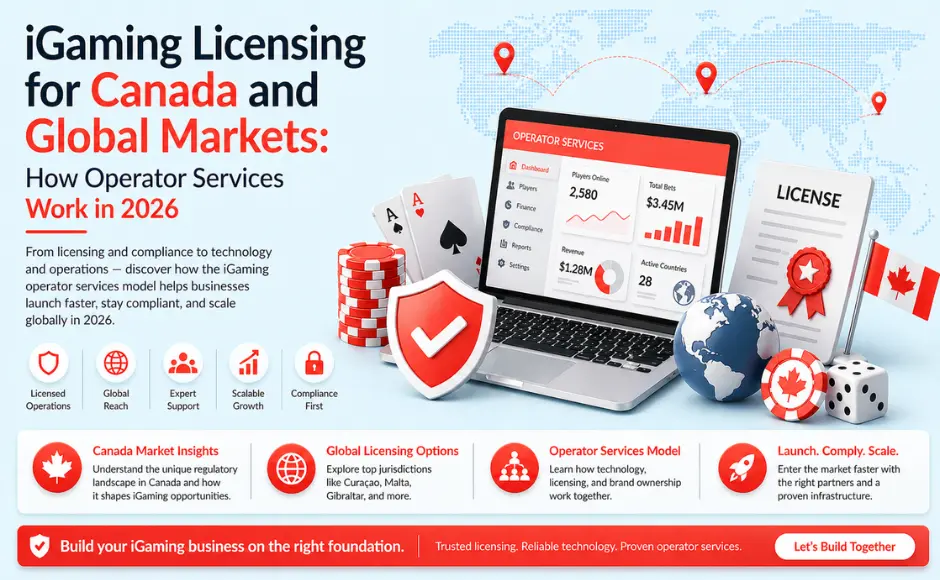
The online gambling industry has never been more competitive — or more regulated.
For entrepreneurs and businesses looking to enter the iGaming space, the question is rarely "can we build the platform?" It's almost always "how do we operate legally?"
This distinction matters enormously, and it's one that catches many newcomers off guard. Technology is the easy part. Licensing, jurisdiction strategy, and compliance infrastructure are where most iGaming ventures stall — or fail entirely.
This article breaks down how the market actually works, with a particular focus on Canada and the international licensing structures that most operators rely on.
Canada Is Not One Market
The single most common misconception about the Canadian iGaming space is that it functions as a unified national market. It doesn't. Gambling regulation in Canada falls under provincial jurisdiction, which means each province operates its own legal framework, its own regulator, and its own rules around who can offer gambling services to residents.
In practice, this creates a fragmented landscape where "operating in Canada" can mean very different things depending on which provinces you're targeting and which model you're using to serve those players.
Ontario stands alone as the only province with a fully open, competitive online gambling market. Since launching its regulated framework in 2022, the province has grown to host over 40 licensed operators, all registered through the Alcohol and Gaming Commission of Ontario (AGCO) and operating under agreements with iGaming Ontario, the subsidiary responsible for managing the market. The model has attracted major international brands and generated billions in annual wagers.
Outside Ontario, the picture is murkier. Most other provinces still operate government-controlled monopolies for online gambling, limiting players to provincial lottery sites. That regulatory gap — combined with the fact that no federal law explicitly prohibits Canadians from accessing offshore platforms — has created the conditions under which international operators have long served the Canadian market with limited legal consequence.
How Most Operators Actually Reach Canadian Players
If you examine the iGaming businesses currently serving Canadian players, the majority don't hold provincial licenses. They operate under one of two alternative models.
The offshore model is by far the most common. Operators obtain licenses from internationally recognized gaming jurisdictions — Curaçao, Malta, Gibraltar, the Isle of Man — and accept players from Canada and other markets where online gambling exists in a legal grey area. This model is cost-effective, faster to launch, and scalable across multiple markets simultaneously. It comes with trade-offs: payment processing can be inconsistent, banking relationships are harder to secure, and operators must stay alert to evolving regulatory pressure in the markets they serve.
The Kahnawake model represents a uniquely Canadian alternative. The Kahnawake Gaming Commission, based in the Mohawk Territory in Quebec, has been issuing online gambling licenses since the late 1990s. It holds a distinct legal status and has historically served as a licensing home for operators wanting a Canadian-linked credential while maintaining the operational flexibility of offshore structures. A number of established iGaming brands still hold Kahnawake licenses alongside licenses from other jurisdictions.
The Major Licensing Jurisdictions
For operators building international iGaming businesses, the choice of licensing jurisdiction is one of the most consequential decisions they'll make. Here's how the primary options compare.
Curaçao eGaming remains the most widely used licensing jurisdiction globally, largely because of its accessibility. Setup costs are lower than European alternatives, the approval process moves relatively quickly, and the license is recognized by players across North America, Europe, and Asia. It's the default entry point for many new operators and the backbone of the offshore market serving Canada.
The Malta Gaming Authority sits at the other end of the spectrum. MGA licensing is expensive, compliance-intensive, and takes significantly longer to obtain — but it unlocks access to regulated European markets and carries a level of institutional credibility that Curaçao cannot match. Major brands operating in multiple regulated jurisdictions typically hold MGA licenses as part of their portfolio.
Gibraltar and the Isle of Man occupy a similar tier to Malta: rigorous, respected, and best suited to operators with serious compliance infrastructure and established player bases.
The right jurisdiction depends on the markets you're targeting, your capitalization, and your timeline. For most businesses entering the space, Curaçao remains the pragmatic starting point.
The Multi-Layer Model: How iGaming Businesses Are Actually Structured
Understanding how iGaming businesses are built requires understanding that technology, licensing, and brand ownership rarely sit in the same hands.
The industry runs on a layered model. A technology provider builds and maintains the platform infrastructure — the sportsbook engine, the casino management system, payment integrations, the back-office. A licensed operator holds the gambling license, owns the legal relationship with regulators, and takes responsibility for compliance obligations including KYC, AML, and regulatory reporting. A brand owner — the client — runs the customer-facing business: marketing, user acquisition, customer support, and commercial positioning.
These three roles can be collapsed into fewer parties in some structures, but the functional responsibilities remain distinct regardless. The license always belongs to someone, and that someone carries the regulatory accountability.
This is the foundation of what's commonly called the white label or operator services model — and it's how a significant portion of online casinos and sportsbooks worldwide are launched.
What "Operator Services" Means in Practice
For businesses looking to enter iGaming without obtaining their own gambling license — a process that can take years and cost hundreds of thousands of dollars in even the most accessible jurisdictions — operator services provide an alternative route.
In this model, a technology provider partners with one or more licensed operators. The provider builds and delivers the platform; the licensed partner provides the legal framework under which the brand can operate. The client business owns its brand, manages its players, and runs its commercial strategy — but does so under an umbrella structure that ties back to the licensed entity.
This approach significantly lowers the barrier to entry. It eliminates the need to engage directly with regulators, build compliance infrastructure from scratch, or navigate the multi-year process of obtaining a primary gambling license. For entrepreneurs with a clear vision for their iGaming brand but limited appetite for the regulatory overhead, it's often the most viable path to market.
It's also worth being clear about what this model doesn't eliminate. Compliance obligations don't disappear — they're handled through the licensed partner. Payment processing still requires careful structuring. Advertising and marketing must stay within the rules of the jurisdictions where players are located. The offshore model in particular carries ongoing exposure to regulatory evolution in player markets, and businesses operating this way need to stay informed about how those markets are moving.
The Compliance Reality
One thing the iGaming industry's rapid growth hasn't changed is the seriousness of compliance obligations. If anything, the regulatory environment is tightening globally, and operators — whether fully licensed or running under an operator services arrangement — are under more scrutiny than at any point in the industry's history.
Canadian players accessing offshore platforms do so in a legal grey area, but that doesn't mean the businesses serving them can ignore compliance entirely. KYC requirements, AML protocols, responsible gambling tools, and data protection standards are expected at every layer of the stack. Payment providers, banking partners, and platform infrastructure vendors increasingly require evidence of compliance before entering commercial relationships. Operators that cut corners on these obligations tend not to last long, regardless of their licensing structure.
For businesses evaluating the offshore model as an entry point, the question isn't whether compliance matters — it's how to build the right partnerships to handle it effectively from day one.
Final Thoughts
The iGaming market in Canada and internationally is large, growing, and genuinely accessible to well-prepared businesses. But the path to operating successfully is more structured than many first-time entrants expect.
Canada's fragmented regulatory landscape means most international operators rely on offshore or hybrid licensing models rather than pursuing provincial registration. Those structures are legitimate and widely used — provided they're built on the right foundations: credible licensing, solid compliance infrastructure, and technology partners who understand the regulatory environment they're operating in.
For businesses that want to move quickly without spending years on licensing applications, the white label and operator services model offers a clear route to market. The key is understanding what that model actually entails — and choosing partners who can deliver on all three layers of the stack.