


Issuing Virtual Cards as a Business in Canada: The Opportunity, the Landscape, and the White-Label Path Forward
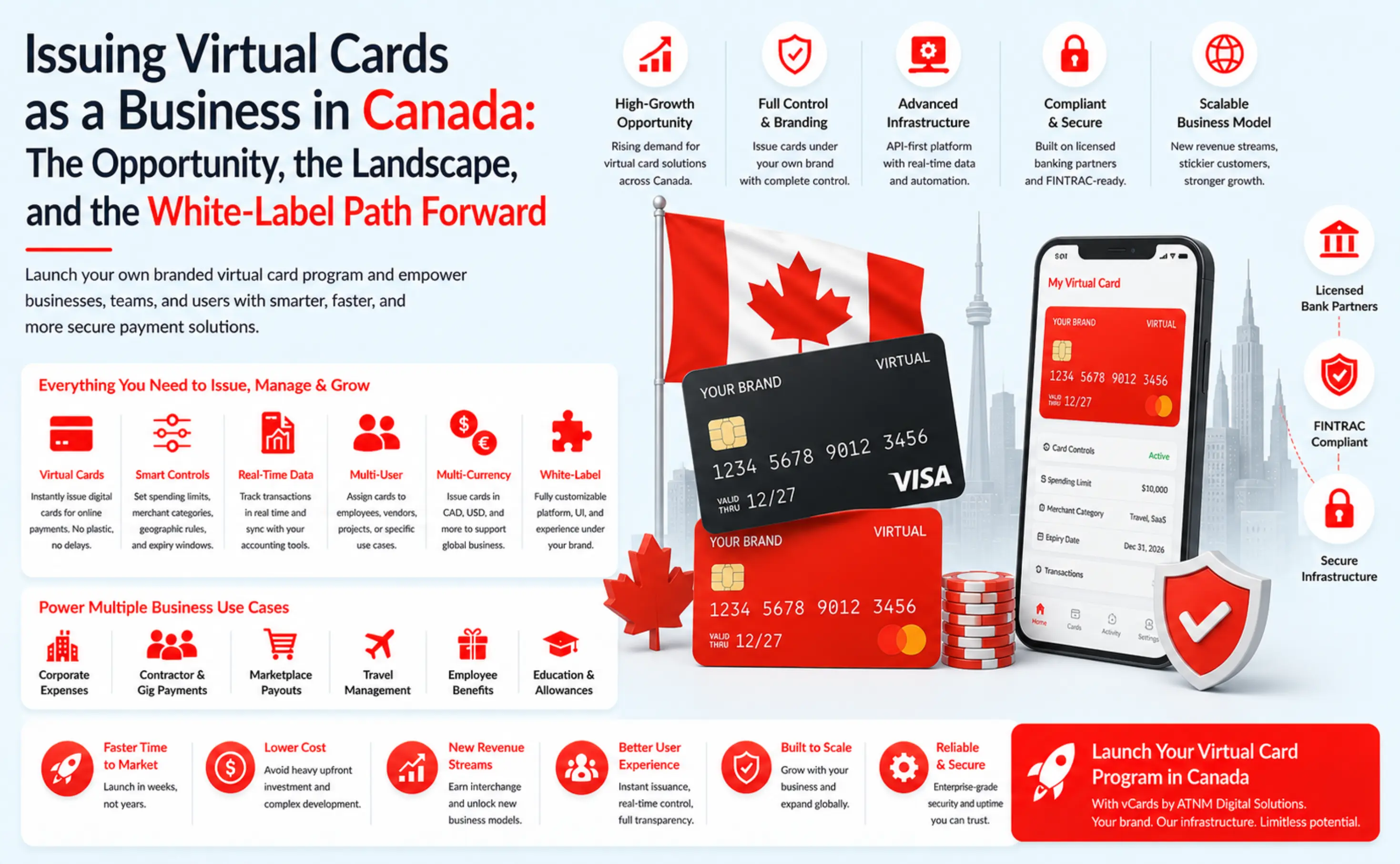
The way Canadians do business has changed faster in the past five years than in the previous twenty. Remote teams, cross-border vendors, SaaS-heavy operations, and real-time financial expectations have dismantled the old model of corporate spending — the one built around plastic cards, paper receipts, and month-end statements. What has emerged in its place is a category of financial infrastructure that most businesses are only beginning to understand: virtual cards.
For Canadian businesses already using virtual cards, the value proposition is clear. For those considering building or issuing virtual card programs, the opportunity is considerably larger — and considerably less explored.
This article is aimed at that second group: companies, fintechs, and entrepreneurs who see the virtual card market not just as a tool for their own operations, but as a product they can bring to market. Specifically, it explores what it means to issue virtual cards as a business in Canada in 2026, what the regulatory and technical landscape looks like, and how white-label solutions — in particular, the vCards platform from ATNM Digital Solutions — are reshaping who gets to participate in this space.
The State of Virtual Cards in Canada Today
A virtual card is, at its most basic level, a digitally generated payment credential — a 16-digit number, expiry date, and CVV — that functions identically to a physical card for any card-not-present transaction, but exists purely in electronic form. There is no plastic to print, no courier required, and no physical compromise to worry about.
What makes virtual cards commercially powerful is what surrounds that credential: the ability to set spending limits, restrict usage to specific merchants or merchant categories, define expiry windows, and tie each card to a specific employee, vendor, project, or transaction. When integrated with accounting platforms, every transaction flows automatically into reconciliation workflows, eliminating one of the most labor-intensive processes in any finance operation.
Adoption in Canada has been growing steadily, but it lags behind markets like the United States and parts of Europe. The reasons are structural. Canada's major banks — the Big Six — have historically been slow to extend virtual card capabilities to small and mid-sized businesses. When they do, the offer is typically limited: a single card per account, minimal controls, no API access, and a process that begins with a credit check and ends weeks later with a piece of plastic arriving by mail.
The gap between what Canadian businesses need and what traditional institutions provide has opened a real window for fintech operators. That window is now wide open.
Why Businesses Want to Issue, Not Just Use, Virtual Cards
There is a meaningful distinction worth drawing here. Most coverage of virtual cards focuses on the business that uses them to manage its own spending. But a parallel and growing market exists for businesses that want to issue virtual cards to others — to their customers, their employees, their contractors, or their ecosystem partners.
Think about the categories of business where this becomes interesting:
An expense management software company that wants to offer corporate cards natively within its platform. A payroll provider that wants to issue instant wage-access cards to workers. A travel management company that wants to create trip-specific spending credentials on demand. A marketplace platform that wants to fund cards for its sellers or contractors. A benefits administrator that wants to issue category-restricted cards for wellness or learning budgets.
In each of these cases, the company does not want to become a bank. It does not want to acquire a banking license, negotiate card network agreements, or build payment infrastructure from scratch. It wants to issue cards under its own brand, with its own controls, and on its own terms — while someone else handles the regulated infrastructure underneath.
This is exactly the problem white-label virtual card programs are designed to solve.
What White-Label Virtual Card Issuance Actually Means
White-label issuance refers to a model where a technology provider — or, in more regulated contexts, a licensed issuing partner — makes its card infrastructure available to third parties, who then deploy it under their own brand. The end user sees a product that belongs entirely to the issuing business. The underlying rails, compliance framework, and network connectivity are abstracted away.
For the issuing business, this model compresses the time to market from years to weeks or months, eliminates the need for specialized regulatory expertise, and allows complete focus on product design, distribution, and customer relationships. For the end user — the cardholder — the experience is seamless and on-brand.
The white-label virtual card market in Canada is still relatively nascent compared to what exists in the United States and the United Kingdom, where card issuance APIs from providers like Stripe have powered entire fintech categories. But the infrastructure is maturing, and the Canadian market is beginning to support serious white-label programs.
ATNM Digital Solutions and the vCards Platform
Among the players building specifically for the Canadian white-label issuance market, ATNM Digital Solutions has positioned its vCards platform as a purpose-built solution for businesses that want to issue, manage, and brand their own virtual card programs without navigating the complexity of card network certification or banking regulation independently.
The vCards platform by ATNM Digital Solutions is built to handle the full lifecycle of a virtual card program: card generation, spend controls, real-time transaction monitoring, cardholder management, and reporting — all exposed through an API that can be integrated into any existing product or back-office system.
What distinguishes the ATNM Digital Solutions approach is the depth of the white-label layer. Businesses that deploy vCards can configure the program entirely around their own brand identity, including the card credentials themselves, the cardholder-facing interface, and the reporting environment that finance teams interact with. The result is a product that looks, feels, and operates as though the issuing business built it internally — without the years and capital that would actually require.
For organizations with existing digital infrastructure — a client portal, a mobile application, an internal finance tool — the vCards API integrates cleanly, allowing card issuance and management to live natively within existing workflows rather than redirecting users to a third-party interface.
The platform also addresses some of the most common friction points that have historically limited virtual card adoption in Canada. Multi-currency support means cards can be denominated in CAD, USD, or other currencies without forcing the cardholder through FX conversion at unfavorable rates. Granular spend controls allow issuers to define not just spending limits but merchant category restrictions, geographic limits, and expiry parameters at the individual card level. And real-time transaction data means that whoever is managing the program — whether an internal finance team or an external administrator — always has a complete and current picture of what is being spent and where.
The Regulatory Landscape for Card Issuers in Canada
Any serious conversation about issuing payment cards in Canada has to engage with the regulatory framework that governs it. Canada's financial services sector is regulated primarily through the Office of the Superintendent of Financial Institutions (OSFI) at the federal level, alongside provincial securities and consumer protection authorities, and through FINTRAC, which administers anti-money laundering and counter-terrorism financing obligations for money service businesses.
Issuing payment cards that operate on networks like Visa or Mastercard requires, at minimum, a relationship with a licensed principal member of those networks — typically a Schedule I or Schedule II bank, or a trust company. Most non-bank businesses cannot become direct card issuers without either obtaining their own banking or trust license or partnering with an entity that holds one.
This is why the white-label model matters structurally, not just commercially. A well-structured white-label program sits on top of a licensed issuing bank, which holds the regulatory relationships and network memberships. The white-label partner — in this case, a company deploying ATNM's vCards platform — operates within the compliance framework established by that issuing bank, typically under a program manager or sponsoring bank model.
For businesses that want to issue cards, this architecture means compliance obligations are shared and clearly delineated. The issuing bank remains responsible for KYC verification of cardholders, AML monitoring, and network compliance. The program manager — the business actually deploying the white-label product — typically carries responsibility for its own business practices, customer agreements, and operational integrity within the program's defined parameters.
Anyone building a card program in Canada should obtain qualified legal and regulatory guidance specific to their business model. The framework above is not legal advice, but rather a description of the general structure that governs most non-bank card issuance in the country.
What Businesses Can Build on a White-Label Virtual Card Platform
The flexibility of the white-label model means the list of products that can be built on top of a platform like ATNM Digital Solutions vCards is genuinely broad. A few of the more compelling categories in the Canadian market:
Corporate Expense Programs for Niche Industries Vertical-specific software companies serving industries like construction, healthcare, professional services, or real estate can embed card issuance directly into their platform. A project management tool for general contractors, for example, could issue project-specific cards to subcontractors, with spend locked to approved vendor categories and capped at the project budget. Receipts attach to transactions automatically, and everything flows into the client's accounting system without manual intervention.
Contractor and Gig Worker Payments The growth of the contingent workforce in Canada has outpaced the payment infrastructure designed to serve it. Issuing virtual cards to contractors — either for expense reimbursement or as a mechanism for paying advances and project installments — offers speed, traceability, and control that wire transfers and cheques simply cannot match.
Embedded Finance for B2B Platforms Marketplace platforms, procurement networks, and B2B commerce platforms that facilitate transactions between buyers and sellers have a natural use case for embedded card issuance. Funding a card at the point of a purchase order, restricting its use to the specific approved vendor, and automatically reconciling the transaction against the PO is a workflow that eliminates entire categories of fraud and administrative overhead.
Corporate Benefits and Allowance Programs HR and benefits platforms can issue category-restricted cards for employee wellness budgets, professional development allowances, or remote work stipends. The card replaces a reimbursement process that typically involves claim submission, approval workflows, and delayed payment — none of which are particularly pleasant for employees or administrators.
Travel Management Travel management companies and expense platforms serving corporate clients can issue trip-specific virtual cards funded to exact budget amounts, locked to relevant merchant categories like airlines, hotels, and ground transport, and automatically expired at the end of the trip. The reconciliation that used to require a dedicated resource can be handled automatically.
Technical Considerations for Building on the vCards Platform
For technical teams evaluating a white-label card issuance platform, the quality of the API and the depth of the documentation are often as important as the feature set itself. A platform that requires extensive custom development to accommodate basic use cases, or that exposes only a subset of its functionality through programmatic interfaces, creates long-term technical debt that limits what can be built.
The ability to receive real-time transaction webhooks is particularly important for programs where the issuing platform needs to respond to spending events — flagging anomalies, triggering approval workflows, or updating budget tracking dashboards as transactions occur rather than after a nightly batch.
The Business Case for Issuing Virtual Cards
The commercial rationale for building a virtual card program varies by business type, but the underlying economics tend to be favorable for program operators.
On the revenue side, interchange — the fee paid by the merchant's bank to the issuing bank on every card transaction — is a share that can be passed, in whole or in part, to the program operator under commercial arrangements negotiated as part of the white-label agreement. For programs that process meaningful volume, this represents a genuine revenue stream that did not exist before card issuance was part of the product. Depending on the card type and transaction mix, interchange rates in the Canadian market typically range from under one percent to over two percent of transaction value.
Beyond interchange, card programs create stickiness. A business that issues cards to its customers, employees, or platform participants has created a payment relationship that deepens engagement and generates transaction data that enriches the overall product. The card becomes a reason to stay in the ecosystem.
On the cost side, the white-label model keeps program economics attractive by eliminating the capital expenditure and operational overhead that independent card issuance would otherwise require. The issuing infrastructure, compliance framework, and network connectivity are provided by the platform and its banking partners. The program operator invests in product development, distribution, and customer support — the areas where it already has expertise and competitive advantage.
Choosing the Right Partner
The quality of a white-label card program depends heavily on the partner providing the underlying infrastructure. For businesses evaluating options in the Canadian market, a few considerations stand out.
Regulatory standing matters above all else. The issuing bank or trust company underpinning the program must hold appropriate licenses and network memberships. A white-label program built on a partner without proper regulatory authorization is not just a compliance risk — it is a business that can be shut down.
Canadian specificity matters in ways that are easy to underestimate. Programs built primarily for the US market often carry structural assumptions — USD denomination, US-based KYC standards, American banking rails — that create friction and cost for Canadian operators and cardholders. ATNM Digital Solutions built vCards with the Canadian market as the primary context, which means CAD support, FINTRAC compliance, and integration with the Canadian payment infrastructure are first-order features rather than afterthoughts.
API quality and documentation determine how long it takes to build and how easy it is to maintain. A white-label partner that provides poor developer tooling forces the building business to absorb complexity that should have been abstracted. Evaluating the API before committing to a platform — through sandbox access, developer documentation review, and reference calls with existing integrators — is not optional.
Support and operational reliability are the unglamorous factors that determine whether a card program actually runs well in production. Card programs touch real money in real time, and when something goes wrong — a card wrongly declined, a limit not applied correctly, a transaction that fails to reconcile — the response time and expertise of the platform's support team determines whether the incident is a minor annoyance or a customer-facing failure.
Where Canada Goes from Here
The virtual card market in Canada is at an inflection point. Enterprise adoption has been underway for several years among large organizations with the resources to build or negotiate custom programs. What is now beginning to happen — and what platforms like ATNM's vCards are specifically designed to accelerate — is the democratization of card issuance for mid-market companies, vertical software businesses, and fintech startups that previously lacked access to the infrastructure required.
This mirrors a pattern that played out in the US market roughly five years ago, when a combination of more accessible issuance APIs, a maturing regulatory framework for program managers, and growing enterprise demand for embedded financial products created a wave of new card programs from non-bank issuers. Canada's market is smaller, but the structural forces are identical, and the timeline is compressed by the fact that operators here can learn from what has already been built elsewhere.
For businesses thinking about this space, the question is less whether virtual card issuance is a viable opportunity in Canada and more whether the timing is right for their specific market and business model. Given the infrastructure now available through white-label platforms, the answer for many is that the timing is better than it has ever been.
Getting Started
For businesses ready to explore virtual card issuance, the practical path forward begins with a conversation about what the card program is actually trying to accomplish. What problem does the card solve for the end user? What controls are required? What systems does it need to connect to? What volume is realistic in year one, and what does scale look like?
ATNM Digital Solutions works with prospective partners through exactly this kind of scoping process, helping organizations understand what a vCards-based program would look like for their specific context before any technical commitment is made. The platform's API-first design means that integration complexity is evaluated early, and the white-label configuration options mean that brand and product requirements can be accommodated without custom development work on the infrastructure side.
Canada is ready for a new generation of card programs built by companies that understand their markets better than any bank ever will. The infrastructure to build them is here.