


Prop Trading Platforms and Regulation in Canada: A Practical Perspective from Industry Consultation
Prop Trading Platforms in Canada: Understanding the Regulatory Position
The rapid growth of proprietary trading platforms over the past several years has raised an important question across multiple jurisdictions: how should these platforms be classified from a regulatory standpoint? In Canada—where financial oversight is both decentralized and notably stringent—this question carries particular weight for founders, investors, and operators entering the space.
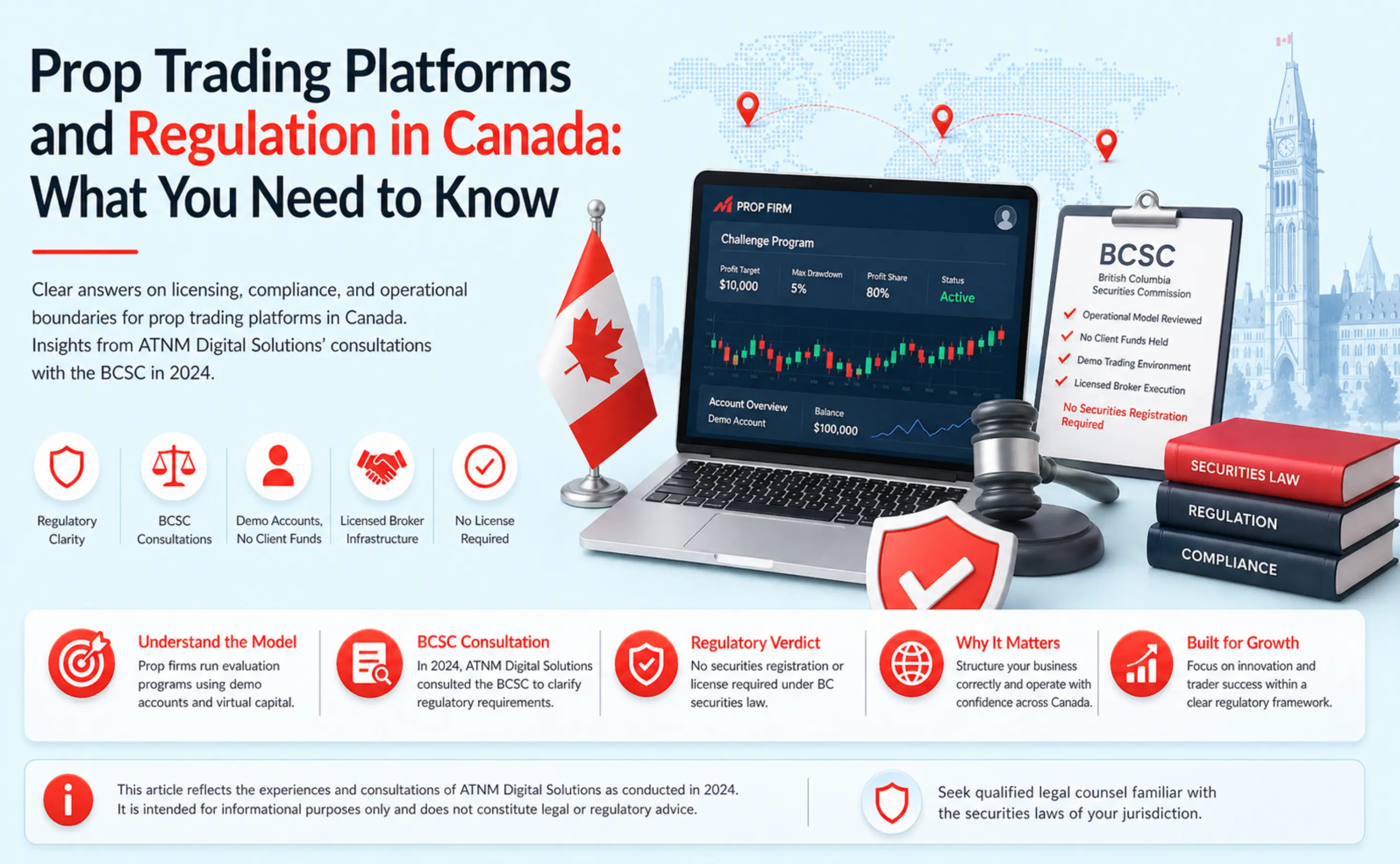
In 2024, ATNM Digital Solutions conducted a series of direct consultations with the BC Securities Commission (BCSC), the regulatory authority responsible for overseeing capital markets activity in the province of British Columbia. These discussions aimed to clarify whether modern prop trading platforms fall within existing regulatory frameworks that govern broker-dealers, investment firms, or other financial service providers.
The outcome of these consultations provides valuable insight into how such platforms are currently viewed by regulators—particularly when structured correctly.

Understanding the Modern Prop Trading Model
To assess regulatory obligations, it is essential first to understand the operational structure of a contemporary prop trading platform.
Unlike traditional financial institutions, a proprietary trading platform does not function as a brokerage. It does not onboard clients for the purpose of managing funds, executing trades on their behalf, or providing direct access to live financial markets.
Instead, the platform offers structured evaluation programs—commonly referred to as “challenges”—through which traders demonstrate their ability to operate within predefined risk parameters. These programs are conducted in simulated trading environments using demo accounts.
The trading data itself is typically sourced via API integrations from licensed third-party brokers operating in regulated jurisdictions. These brokers provide the market conditions, price feeds, and execution environments that mirror real-world trading, while ensuring that all activity remains confined to non-custodial, simulated accounts.
Key Regulatory Considerations in Canada
Based on the 2024 consultations with the BCSC, a clear distinction was established between prop trading platforms and regulated financial entities.
The primary factors influencing this distinction include:
Regulatory Position: No Licensing Requirement (Under Current Model)
Taking these factors into account, the general position communicated during consultations with the BCSC was that, under this specific operational model, proprietary trading platforms are not required to obtain financial services licenses or regulatory approvals to operate within British Columbia.
This conclusion is grounded in the fact that such platforms do not engage in activities traditionally subject to securities regulation—namely, custody of client assets, execution of trades, or provision of investment advice.
Instead, they are viewed as providers of educational and evaluative technology products.
Important Limitations and Considerations
While this interpretation provides a degree of operational clarity, it should not be misconstrued as a blanket exemption applicable to all variations of prop trading businesses.
Regulatory obligations may arise if the platform model deviates in any of the following ways:
Any shift toward these functions could bring the platform within the scope of securities regulation or other financial oversight frameworks.
The Role of Technology Providers
Companies such as ATNM Digital Solutions operate strictly as B2B technology providers, delivering white-label infrastructure that enables clients to launch their own prop trading platforms.
Within this structure, the responsibility for regulatory compliance remains with the operator, particularly when integrating with third-party brokers, payment providers, or external financial services.
The technology itself does not constitute a regulated activity; however, how it is deployed may determine the regulatory classification of the business using it.
Conclusion
The regulatory landscape surrounding proprietary trading platforms in Canada continues to evolve, but current interpretations—particularly those informed by direct consultation with the BCSC—indicate that platforms operating strictly within a simulated, non-custodial framework are not subject to licensing requirements in British Columbia.
This position reflects a broader regulatory principle: oversight is applied based on function, not branding. As long as a prop trading platform does not engage in activities characteristic of financial intermediaries, it remains outside the scope of traditional securities regulation.
For entrepreneurs and companies entering this space, the implication is clear: structure matters. Maintaining a clear separation between technology, simulation, and regulated financial activity is not only a matter of operational design—it is fundamental to remaining compliant within Canada’s regulatory environment.