


What Is the Operator Services Module and How Does It Work?
What Is the Operator Services Module and How Does It Work?
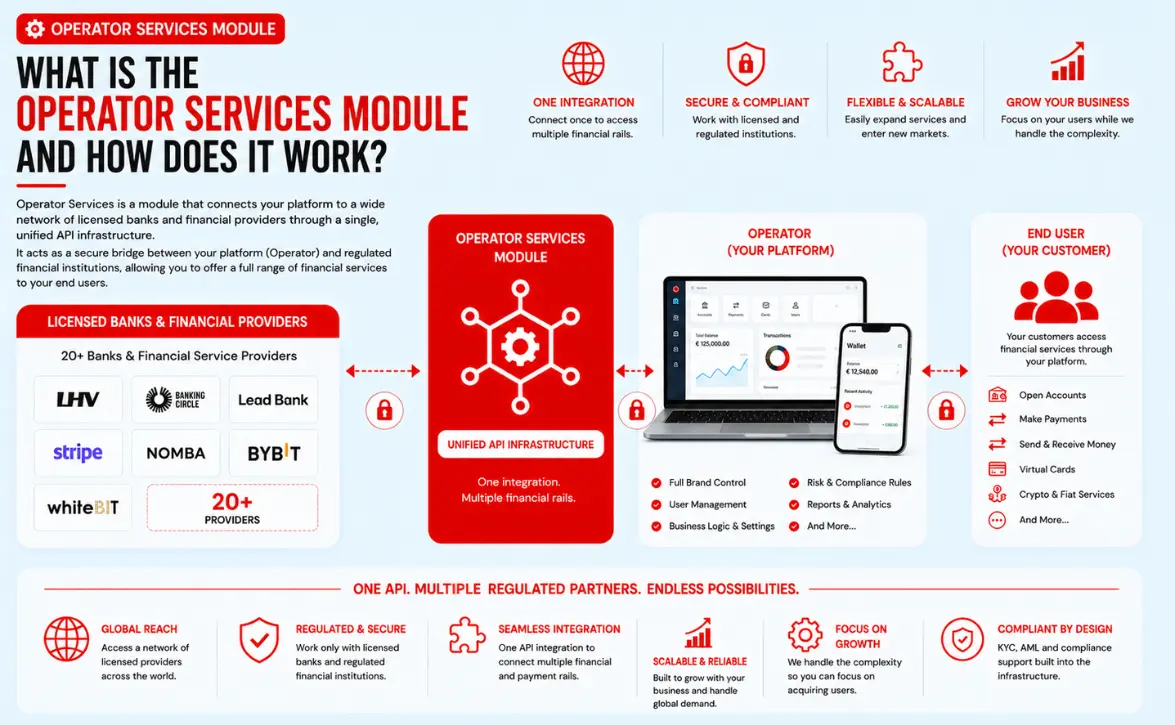
Operator Services is the infrastructure layer that connects an Operator's financial platform with a network of licensed banks, payment institutions and financial infrastructure providers through API integrations.
Instead of building and maintaining separate integrations with multiple banks, payment providers, account providers and digital asset infrastructure companies, an Operator can access supported financial services through a unified infrastructure integrated directly into its platform.
On one side, Operator Services communicates with the infrastructure of regulated providers and banks. On the other side, it connects to the Operator's platform, through which financial functionality is delivered to the Operator's end users.
In simple terms: Operator Services acts as the technological bridge between the Operator and the financial infrastructure required to provide accounts, payments, transfers, digital asset functionality and other supported financial services.
How Operator Services Works
The infrastructure can be represented as four interconnected layers:
Banks & Financial Providers
Licensed banks, payment institutions, payment infrastructure, acquiring, account and digital asset providers.
Operator Services
Unified integration and orchestration layer connecting multiple financial providers through a common infrastructure.
Operator
The Operator manages its branded platform, customer interface, business model, pricing and available services.
End User
Personal or business customers access supported services directly through the Operator's branded platform.
The Infrastructure From Provider to End User
The Operator does not need to expose the technical infrastructure of every underlying provider separately within the customer interface.
Operator Services creates a unified technological layer between the financial infrastructure and the Operator's platform.
Requests generated by an end user are transmitted from the Operator's platform to Operator Services. The infrastructure processes the request and communicates with the appropriate provider according to the service, customer jurisdiction, currency, payment rail, provider availability and applicable compliance rules.
Example: How a Transaction Moves Through Operator Services
What Is Included in Operator Services?
Operator Services combines multiple infrastructure components required to connect a financial platform with external regulated providers.
Infrastructure — Unified API Layer
A common integration layer allows the Operator's platform to interact with different providers without creating a completely independent integration architecture for every provider.
Connectivity — 20+ Banks and Financial Providers
The infrastructure connects multiple banking, payment and digital asset providers that can be used according to geography, service availability, compliance requirements and the Operator's configuration.
Accounts — Account & Virtual Account Infrastructure
Where supported by the applicable provider, the infrastructure can enable customer accounts, virtual accounts, IBANs and other local or international account details.
Payments — Payment Rails
Depending on the provider and jurisdiction, supported infrastructure may include SEPA, SEPA Instant, SWIFT, local transfers and other domestic or international payment rails.
Compliance — KYC & KYB Infrastructure
Customer verification can be routed through the compliance infrastructure required by the underlying provider, including KYC, KYB, sanctions screening and other required checks.
Digital Assets — Crypto & Stablecoin Infrastructure
Selected configurations may provide access to digital asset infrastructure, exchange functionality, stablecoin settlement, crypto conversion or related services through supported providers.
FX — Currency Conversion
Foreign exchange and currency conversion functionality can be connected where supported by the selected financial infrastructure.
Automation — Webhooks & Status Updates
Provider events and transaction updates can be transmitted back to the Operator's platform automatically, allowing balances, transactions and statuses to remain synchronized.
Routing — Provider Routing
Different providers can serve different products, currencies, jurisdictions and customer categories. Operator Services creates the infrastructure required to route those operations.
Management — Centralized Platform Integration
Instead of managing multiple disconnected systems, supported services are integrated into the Operator's platform through a common infrastructure layer.
A Network of More Than 20 Financial Infrastructure Providers
One of the principal advantages of Operator Services is that the architecture is not built around a single provider.
The infrastructure can connect the Operator with a network of more than 20 banks, payment institutions, payment infrastructure companies and digital asset providers.
Examples of Infrastructure Providers. Depending on the product, jurisdiction, customer profile and availability, the provider ecosystem can include infrastructure from companies such as:
Provider availability is subject to jurisdiction, service type, customer eligibility, compliance requirements, provider approval and technical availability. Not every provider or service is necessarily enabled for every Operator.
Licenses & Regulatory Oversight
The banks and financial providers connected through Operator Services operate under regulatory frameworks in multiple jurisdictions, including:
Why Use Multiple Providers?
Financial infrastructure is highly fragmented. One provider may offer strong European payment coverage, another may provide U.S. banking infrastructure, while another may specialize in acquiring, cards, foreign exchange or digital asset services.
Building a platform around only one provider can therefore create significant limitations.
The multi-provider architecture of Operator Services is designed to provide greater flexibility.
Who Does What?
Operator Services separates the customer-facing platform from the underlying regulated financial infrastructure.
Financial Providers
Regulated financial services, banking or payment infrastructure, payment execution, account infrastructure, applicable compliance controls, and safeguarding where applicable.
Operator Services
API connectivity, provider integrations, request routing, data synchronization, service orchestration, and technical infrastructure.
Operator
Own brand and domain, customer-facing platform, customer acquisition, product configuration, pricing and commercial model, and the customer relationship.
What Does the End User See?
The end user interacts with the Operator's platform rather than with the Operator Services integration layer.
For example, a customer may log into the Operator's branded platform, complete an onboarding process, obtain available account details, view a balance, create a beneficiary or initiate a transfer.
Behind the interface, Operator Services communicates with the relevant provider infrastructure and returns the required information to the platform.
Does Operator Services Replace a Bank?
No. Operator Services is not itself a bank and does not replace the regulated institutions providing the underlying financial services.
Its role is to provide the technological and operational infrastructure connecting the Operator's platform with the appropriate regulated providers.
Regulated banking, payment or digital asset services are performed by the applicable underlying provider within its own regulatory permissions, compliance framework and supported jurisdictions.
One Integration Instead of Multiple Independent Connections
Without an infrastructure layer such as Operator Services, a fintech company may need to develop and maintain separate technical integrations for account providers, banks, payment processors, digital asset infrastructure, verification providers and other services.
Each integration may have its own API structure, authentication system, webhooks, data format, compliance requirements and operational processes.
Operator Services is designed to consolidate these connections into a common infrastructure.
Traditional Infrastructure
Operator Services Infrastructure
Designed for Geographic Expansion
A multi-provider infrastructure also makes it possible to expand the financial capabilities of the platform as the Operator enters additional markets.
Instead of requiring the entire platform architecture to be rebuilt for every new country, Operator Services can connect additional infrastructure to the existing Operator environment where the required providers and services are available.
This model is particularly useful for fintech platforms operating across Europe, North America and other international markets where account types, payment rails, regulatory requirements and provider availability may differ.
Key Advantages of Operator Services
Operator Services in One Sentence
Operator Services is the API infrastructure that connects an Operator's branded financial platform with a network of more than 20 banks, payment institutions and financial infrastructure providers, allowing supported financial services to be delivered to end users through one integrated platform environment.
The Operator maintains the brand and customer relationship, Operator Services provides the connectivity and orchestration layer, and the underlying regulated providers deliver the applicable financial infrastructure.