


Stablecoins Are Now Integrated into the EBank Platform
Stablecoins Are Now Integrated into the EBank Platform
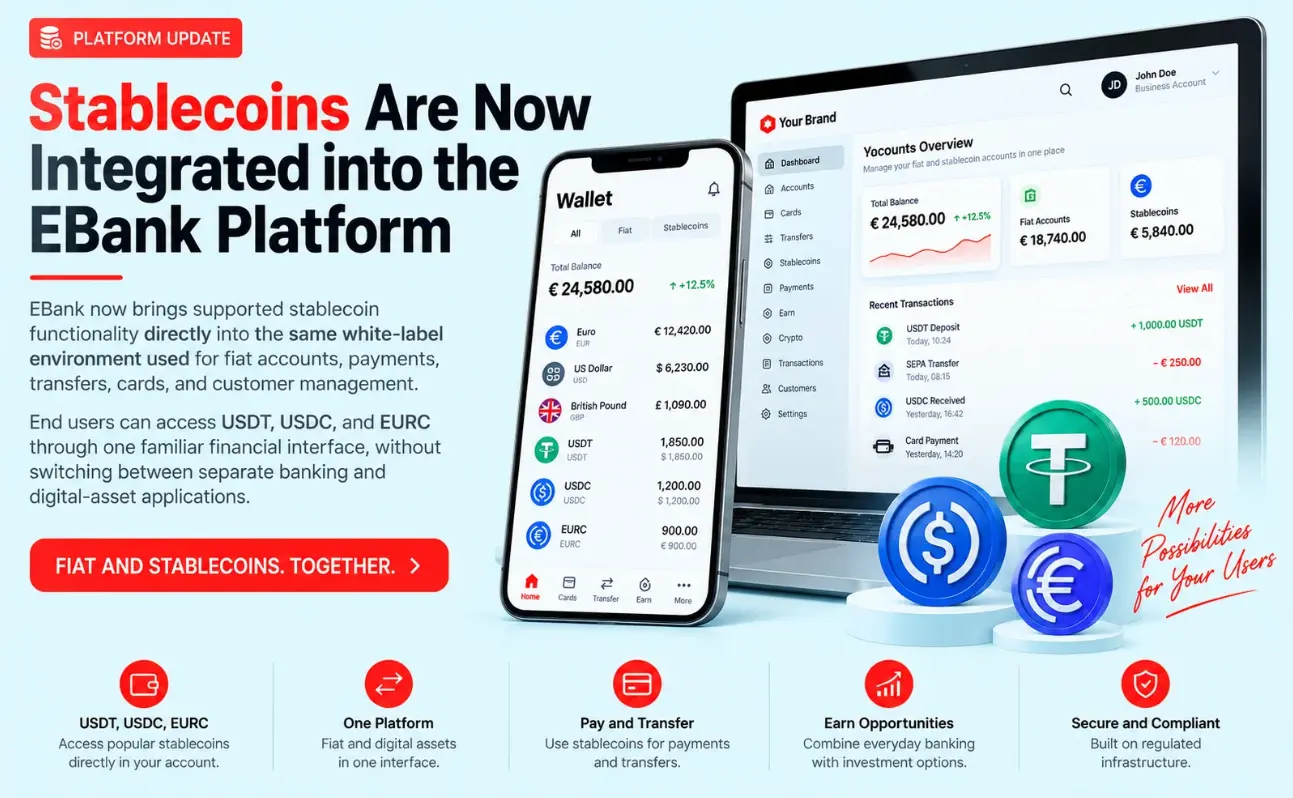
EBank now brings supported stablecoin functionality directly into the same white-label environment used for fiat accounts, payments, transfers, cards, and customer management. End users can access USDT, USDC, and EURC through one familiar financial interface, without switching between separate banking and digital-asset applications.
This update expands EBank from a traditional white-label fintech platform into a more flexible financial ecosystem where supported fiat currencies and stablecoins can work together.
Operators can now offer eligible end users a clearer way to view, manage, transfer, and convert supported digital balances alongside USD, EUR, and GBP accounts. The exact functions available to each operator and user depend on the activated modules, jurisdiction, compliance approval, supported markets, and connected financial infrastructure.
What Are Stablecoins?
Stablecoins are digital assets designed to maintain a value linked to a reference currency. Unlike digital assets whose market price can change significantly within a short period, fiat-referenced stablecoins are intended to provide a more stable unit for digital payments, transfers, settlement, and balance management.
The latest EBank update introduces support for three widely used stablecoins:
USDT
A US dollar-referenced stablecoin commonly used for digital transfers, settlement, and moving value between supported platforms and markets.
USDC
A US dollar-referenced stablecoin designed for digital payments, transfers, treasury operations, and integration with modern financial applications.
EURC
A euro-referenced stablecoin that allows eligible users and businesses to manage euro-denominated value within supported digital-asset infrastructure.
Fiat Accounts
Supported stablecoins can be used alongside the EBank multicurrency environment, which includes USD, EUR, and GBP account functionality where available.
What Is Now Available to End Users?
The integration is designed to make stablecoins understandable and usable within an everyday financial interface. Instead of treating digital assets as a separate technical product, EBank places the available stablecoin functions alongside the tools users already understand.
Supported assets, networks, transaction types, limits, fees, and geographic availability are determined by the operator's activated configuration and the applicable compliance framework.
One Platform for Fiat and Stablecoin Balances
For many users, the biggest difficulty with digital assets is fragmentation. One application may be used for a bank transfer, another for holding stablecoins, and another for converting or spending funds.
EBank reduces that fragmentation by bringing the available services into a single branded environment. Users can move between supported financial functions without leaving the operator's platform.
How Stablecoin Conversion Works
Stablecoin conversion connects digital balances with the fiat functionality already available in EBank. When the service is enabled, an eligible user selects a supported asset, enters the amount, reviews the applicable rate and fee, and confirms the conversion.
- Select the source balance. The user chooses an available USDT, USDC, EURC, or supported fiat balance.
- Select the destination balance. The user chooses the supported asset or currency to receive.
- Review the transaction. The interface displays the conversion details, applicable rate, fee, and final amount.
- Confirm the conversion. After confirmation and compliance checks, the converted amount is credited to the destination balance.
- Use the funds. The resulting balance can be managed through the functions enabled for that user, including eligible transfers and payments.
The standard stablecoin conversion tariff is shown on the current Pricing page. Rates and tariffs may be updated, and the final amount is always displayed to the user before confirmation.
From Stablecoins to Everyday Payments
The practical value of stablecoin integration is not limited to holding a digital balance. It creates a bridge between blockchain-based value and familiar payment tools.
Where the relevant services are activated, users can convert a supported stablecoin balance into an available fiat balance and then use those funds through the existing EBank payment environment. This may include outgoing transfers and virtual Visa card payments with Apple Pay or Google Pay support, depending on the user's country, account status, limits, and activated modules.
Online Purchases
Converted balances can support eligible payments with an activated virtual card wherever the card program is available.
Digital Wallet Payments
Eligible virtual cards can be added to Apple Pay or Google Pay for convenient supported payments.
Bank Transfers
After conversion, available fiat balances can be used with supported SEPA, SEPA Instant, SWIFT, or ACH functionality.
Cross-Border Use
Stablecoins can provide an additional settlement and value-transfer option for eligible users operating across supported markets.
What This Update Means for Personal Users
Personal users can access supported stablecoin functions through the same type of interface they use for balances, transfers, cards, and transaction history. This removes much of the complexity normally associated with switching between traditional finance and digital assets.
What This Update Means for Business Users
For eligible business customers, stablecoins can offer another way to receive value, manage international activity, convert digital balances, and coordinate fiat payment needs.
Stablecoin availability does not replace business KYB, transaction monitoring, sanctions screening, or requests for supporting documents. Business use remains subject to the same risk-based compliance standards applied to the rest of the financial infrastructure.
Compliance and Transaction Monitoring
Stablecoins can move through blockchain networks, but their use inside EBank is not anonymous or outside the compliance framework. Access to the functionality is subject to customer verification, supported-market rules, transaction monitoring, sanctions controls, and risk-based limits.
What EBank Operators Can Offer
The update allows approved operators to extend their white-label product beyond conventional account and payment functionality. Stablecoins can become part of the operator's own customer proposition without requiring the operator to build separate wallet, conversion, compliance, and transaction-management systems from the beginning.
Branded Experience
Stablecoin functionality is presented inside the operator's EBank platform, under its approved brand and domain.
Personal and Business Users
The available functionality can support eligible personal and business customer journeys.
Integrated Administration
Operators can monitor users, balances, transactions, verification status, and available services through the administration environment.
Commercial Flexibility
Operators can build their own pricing model and customer proposition while accounting for applicable platform and transaction tariffs.
Frequently Asked Questions
Which stablecoins are supported?
The current EBank integration supports USDT, USDC, and EURC, subject to the operator's configuration, supported networks, jurisdiction, and customer eligibility.
Can users convert stablecoins into fiat?
Yes. Eligible users can convert supported stablecoins into available fiat balances where the conversion service has been activated.
Can users buy stablecoins with fiat balances?
Yes, where enabled. Users can convert available fiat balances into supported stablecoins after reviewing the applicable rate, fee, and transaction details.
Can stablecoins be used with a virtual card?
Supported stablecoins can be converted into an available fiat balance, which can then be used for eligible virtual card payments. Availability depends on the activated card and conversion services.
Are stablecoin transactions anonymous?
No. Users must complete the applicable verification process, and transactions remain subject to compliance screening, monitoring, limits, and supported-market rules.
Are stablecoins the same as bank deposits?
No. Stablecoins are digital assets and should not be described as traditional bank deposits. Their structure, protections, risks, and availability differ from fiat accounts.
Is the value of a stablecoin guaranteed?
No digital asset is risk-free. Stablecoins are designed to track a reference currency, but their market value, liquidity, issuer structure, and technical operation can still create risks.
Is the functionality available worldwide?
No. Availability depends on the operator's activated modules, customer country, supported market, verification status, transaction type, and compliance approval.
A More Connected Financial Experience
The integration of USDT, USDC, and EURC brings stablecoin functionality into the same EBank environment used for multicurrency accounts, transfers, virtual cards, and customer management.
For end users, this means a simpler way to manage supported digital and fiat balances from one interface. For operators, it creates an opportunity to launch a more complete fintech product that connects modern stablecoin functionality with familiar financial services.
Stablecoins are no longer treated as an isolated feature. They are becoming part of an integrated financial journey built for everyday personal and business use.
Explore the Updated EBank Platform
Learn more about EBank, available Operator Services, supported markets, and the applicable platform and transaction tariffs.